In the world of commercial property management, we often focus on the physical structure—the roof, the walls, and the foundation. But in today’s digital age, protecting commercial properties before a disaster extends far beyond brick and mortar. It encompasses the invaluable data that keeps your business running, the operational plans that ensure continuity, and the proactive measures that minimize downtime.
The infographic below highlights four critical steps every commercial entity needs to take. Let’s dive into each point and why it’s more important than ever.
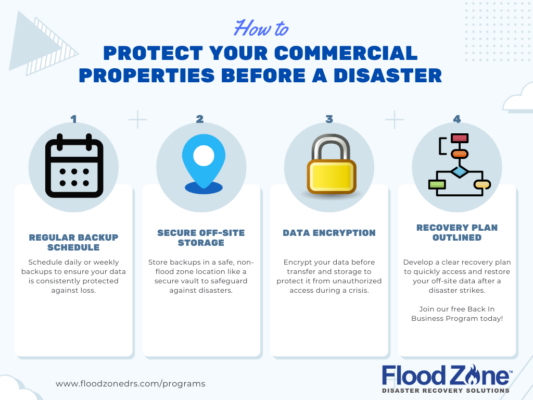
1. Regular Backup Schedule: Your Digital Insurance Policy
In an era where ransomware attacks, system failures, and natural disasters can wipe out years of digital records in an instant, a regular backup schedule is non-negotiable. This isn’t just for large corporations; even small businesses rely heavily on digital files, from customer databases to financial records and operational plans.
Why it matters:
- Data Loss Prevention – A comprehensive backup strategy ensures that even if your primary systems are compromised or destroyed, a recent copy of your critical data exists.
- Business Continuity – With accessible backups, your business can restore operations faster, minimizing the financial impact of downtime.
- Compliance – Many industries have regulatory requirements for data retention and disaster recovery, making robust backups a legal necessity.
Helpful Tip! Think of this as the digital equivalent of having multiple copies of important physical documents stored in different locations. Consult with your IT partner or managed service provider to establish and test a consistent schedule.
2. Secure Off-Site Storage: Location, Location, Location (for your data)
Just as you wouldn’t store all your physical valuables in one place, your digital backups need geographic diversification. Storing backups in a safe, non-flood zone location, ideally within a secure system, is paramount.
Why it matters:
- Protection from Localized Disasters – If your primary property is hit by a hurricane, flood, or fire, an off-site backup ensures your data is unaffected.
- Enhanced Security – Secure systems offer protection against theft, power outages, and adverse environmental conditions that could compromise digital media.
- Accessibility – Immediate access to off-site data is crucial for rapid recovery if your primary site fails.
Helpful Tip! Cloud-based solutions often fulfill this requirement, but it’s essential to thoroughly understand your provider’s physical data center locations and their own disaster recovery protocols.
3. Data Encryption: Your Digital Fortress
Even with backups and off-site storage, the security of your data during transfer and storage cannot be overlooked. Data encryption acts as a digital fortress, protecting your information from unauthorized access.
Why it matters:
- Cybersecurity – Encryption guards against cyber threats, ensuring that even if data is intercepted, it remains unreadable without the correct decryption key.
- Privacy and Compliance – For businesses handling sensitive customer information or proprietary data, encryption is vital for maintaining privacy and adhering to regulations like GDPR or HIPAA.
- Integrity – It helps ensure that your data remains unaltered and uncorrupted during its journey to off-site storage or backup locations.
Helpful Tip! Establishing strong encryption protocols with your IT team is a fundamental step in comprehensive data protection.
4. Recovery Plan Outlined: Your Roadmap to Resilience
Having backups is one thing; knowing how to use them to restore operations is another. Developing a clear, tested Recovery Plan is the cornerstone of business resilience. This plan outlines the steps needed to quickly access and restore your off-site data and resume business functions after a disaster.
Why it matters:
- Minimizes Downtime – A well-defined plan eliminates guesswork and allows for a swift, coordinated response, significantly reducing the time your business is non-operational.
- Clear Roles and Responsibilities – It designates who does what, when, and how, thus preventing confusion during a crisis.
- Includes Professional Support – This is where a partnership with a commercial priority response program, like our Back in Business Program, becomes invaluable. This plan ensures that physical damage mitigation and building recovery runs immediately and in parallel with your internal data recovery efforts.
Beyond the Screen: Physical Preparedness is Key
While digital readiness is crucial, remember that physical preparedness goes together. For a truly comprehensive strategy, you need to ensure your physical property is ready for the worst.
Join our free Back in Business Program today! This program provides the framework for a rapid physical recovery, ensuring your structure is secured and restored quickly so that your IT team can get your entire operation back online faster.
Download our FREE Hurricane Prep Checklist for Commercial Properties to get a detailed guide on securing your physical assets and coordinating with expert responders. This checklist complements the digital steps outlined above, offering an all-inclusive approach to disaster readiness.
Protecting your commercial property in today’s environment means safeguarding both your physical assets and your digital infrastructure. By following these four steps and partnering with your local restoration expert, you can build a truly resilient business, ready to withstand whatever challenges come its way!